

Social Prescribing Day 2026

In recognition of Social Prescribing Day, Healthwatch Hampshire takes a closer look at the essential role social prescribers play in our local communities.
Background
The World Health Organisation defines health as “a state of complete physical, mental and social well-being and not merely the absence of disease or infirmity”. Published in July 2025, the 10 Year Health Plan for England1 describes the NHS as “hospital-centric, detached from communities and organises it’s care into multiple, fragmented siloes”. This makes it challenging to provide a coordinated, cohesive service that is centred around the patient, and supports all elements that are required for a person’s well-being. Many initiatives have been implemented by the government to work towards achieving a more joined-up care system, that works to achieve their 3 aims of:
Hospital to community
Analogue to digital
Sickness to prevention
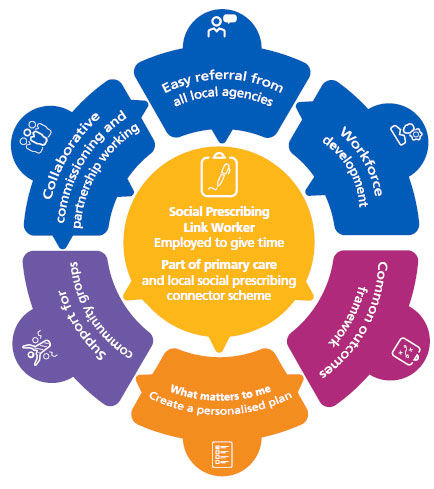
Social prescribers, also known as link workers, play an essential role in creating patient-focused wellness, and as of May 2025, there are 90 social prescribers working in GP practices across Hampshire and the Isle of Wight2.
The role
Social prescribing is a way for healthcare professionals to refer patients to non-clinical services in the community. Social prescribers work with people to understand their individual needs and introduce them to local services that can provide practical and emotional support. Social prescribers are not healthcare professionals; their role is to support non-medical needs that contribute to people’s overall health and wellness. They are trained to assist patients with issues that influence overall health and well-being, such as social isolation, financial worries and lifestyle choices. They can offer a more holistic approach that is individual to the patient’s needs.
What they may be able to support you with
A social prescriber will be able to help you access services that are right for you. This might include:
Helping you to meet people through community groups and shared interests.
Supporting you to find a new hobby by introducing you to local groups, such as gardening, art, crafts.
Working with you to find an exercise routine that suits you, such as walking groups.
Signposting to agencies or organisations that can help with financial issues.
Debbie Thompson has been a Social Prescriber for over three years, working at Mosaic Primary Care Network in Basingstoke. She says:
"My role as a social prescriber is to connect people to community activities and services in order to help improve their overall health and wellbeing.
It's about giving people time to talk and understanding what matters to them. Helping to empower them to access practical, social and emotional support in order to make positive lasting changes.
I believe the role of social prescribing is crucial in order to provide a holistic approach to healthcare as they can address many non medical issues that can affect your health such as social isolation, financial and housing worries.
I believe social prescribing can really help people by giving them the information and the confidence so that they can manage their own issues and find practical solutions that work for them."
How to access a social prescriber
You may be referred to a social prescriber by a healthcare professional, such as a GP or nurse. If you think you would benefit from the service, many GP practices offer self-referral. Contact your GP surgery and ask for an appointment with the social prescriber.
We want to hear from you! Please share your experiences of working with social prescribers and how they have supported you by emailing enquiries@healthwatchhampshire.co.uk


Comments